
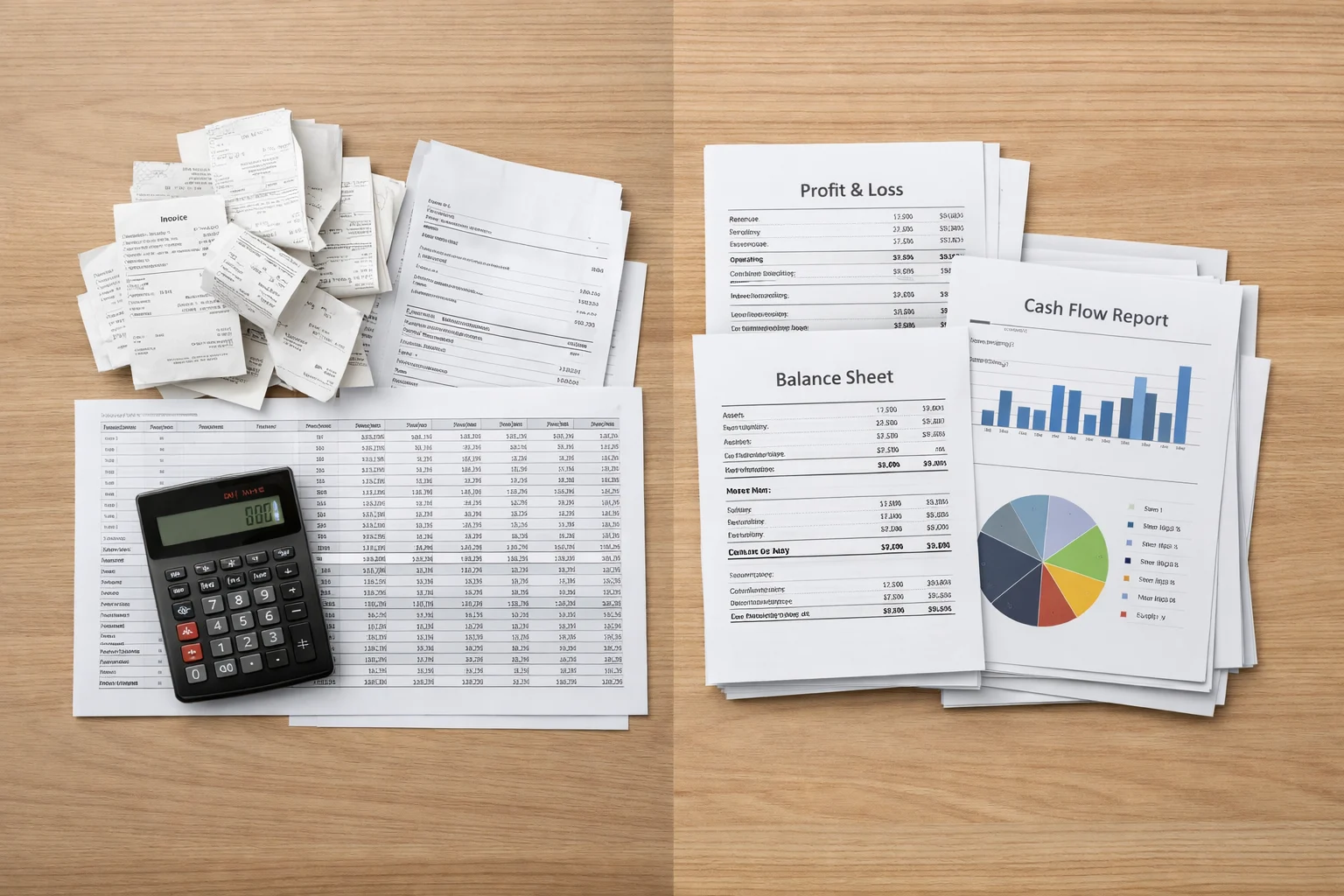
You have just set up a limited company. Someone tells you to get your bookkeeping sorted. Your bank asks whether you have an accountant. A friend says they are the same thing. You nod and move on, still not quite sure what you actually need.
This is one of the most common points of confusion for UK small business owners. People use the two terms interchangeably, but they cover different work. Getting it wrong can cost more to fix than to avoid.
This article explains what each one involves, how they fit together, and how to work out what your business needs.
Quick answer
Bookkeeping is the regular recording of your financial transactions. Accounting is the analysis, interpretation, and compliance work built on top of those records. Most UK small businesses need both. The balance depends on your structure, size, and obligations.
What does bookkeeping actually involve?
Bookkeeping is the day-to-day recording of your financial transactions. Every sale, purchase, payment, and receipt gets logged. Bank accounts get reconciled. Invoices get matched. The result is a current view of your business finances. It only works if you do it consistently. Records that are months out of date are of little use when you need to make decisions.
The rhythm matters as much as the task itself. A business that updates its records weekly knows where it stands. One that waits until January does not. Catching up is always harder than keeping up.
Good bookkeeping is not complicated in concept. But it needs consistency, accuracy, and a solid understanding of what to record and how. Most business owners underestimate that last part until something goes wrong.
What does an accountant actually do?
An accountant takes your financial records and handles the compliance work on top of them. They prepare year-end accounts, deal with your tax position, and file with HMRC and Companies House. They also advise on financial decisions. They explain what your numbers mean for the business, not just what they show.
That is a different job from recording transactions accurately. You need a professional qualification to do it properly. Tax law changes. HMRC practice changes. Keeping up with that is a job in itself.
For sole traders and directors, this includes self assessment tax returns. The obligations go well beyond what bookkeeping alone covers.
Where does bookkeeping end and accounting begin?
The handoff point is where your records become the input for someone else’s work. An accountant preparing your tax return or year end accounts works from your books. If those books are incomplete or wrong, everything built on top of them is compromised.
That is the part most people miss. Clean bookkeeping does not just keep you organised. It also affects the quality of everything that follows.
Why does the distinction matter for your business?
Most HMRC problems and cash flow issues start with a bookkeeping or accounting gap. Bad bookkeeping means you do not have an accurate picture of your business. Missing accounting means your filings are not right. Both carry consequences. Knowing which problem you have helps you fix the right one.
The mix your business needs is not fixed. It changes as your circumstances change.
Sole traders, freelancers, and the self-employed
For simpler income structures, bookkeeping tends to dominate the day to day work. The accounting requirements are real, but they happen at fixed points, not all the time. The risk is underestimating how much good bookkeeping matters when those moments arrive.
Sole traders must keep records of business income and expenses for their self assessment return. Keep them for at least five years after the 31 January deadline.
Limited companies and directors
The accounting side matters more once a company structure is involved. Directors, shareholders, payroll, and statutory filings all bring their own obligations and decisions. They affect each other. That is usually where things go wrong if no professional is overseeing the lot.
Directors must maintain company and accounting records showing the financial position at all times. Statutory accounts must be filed with Companies House each year.
Do you need a bookkeeper, an accountant, or both?
Most UK small businesses need both. A bookkeeper keeps your records current. An accountant turns those records into filings, tax positions, and advice. The question is usually not which one you need. It is whether you have gaps in either, and what those gaps are costing you.
Most small businesses do not need to choose between bookkeeping and accounting. They need to understand how the two connect and make sure neither has a gap.
A business without steady bookkeeping hands its accountant a problem, not records. A business that keeps its own books without accounting input may be compliant. But it may still miss decisions that would have made a real difference.
What works depends on your business type and your obligations. If you also need financial planning for small businesses, the right firm handles both.
DASA Accountancy covers outsourced bookkeeping services and full accounting support from one team.
Get in touch to find out what your business needs now and what it is missing.
This article gives general information about bookkeeping and accounting for UK small businesses. It is not financial, tax, or legal advice. Every business is different. Speak to a qualified accountant for advice specific to your circumstances.